.png)
Building a real connection with clients isn't about a clever sales tactic; it’s about a fundamental shift in mindset. You have to move away from thinking about transactions and start focusing on genuine, human relationships. It’s the difference between a one-off sale and a long-term partner who champions your work.

Think about it: in today's market, your competitors can match your prices or copy your features. What they can't replicate is the trust and connection you build with your clients. When people feel seen, heard, and genuinely cared for, they stick around. More than that, they become your most vocal advocates.
This kind of powerful connection doesn't just happen by chance. It's built on a few core principles that you have to practice intentionally.
Real, lasting rapport isn't a fluke. It's built brick by brick through deliberate actions that show you're more than just a service provider—you're a partner invested in their success.
Here's a breakdown of what really matters when you're trying to forge those connections.
This table outlines the foundational elements that turn a standard client interaction into a strong, collaborative partnership.
By mastering these pillars, you create a dynamic where clients see you as an essential part of their team.
By focusing on these pillars, you move beyond being a mere vendor and become a trusted advisor—a critical distinction that drives long-term loyalty and success.
The numbers back this up in a big way. We all know it's expensive to find new customers—in fact, it can cost 5 to 25 times more than just keeping the ones you have. That alone should make retention a top priority.
Even better, loyal clients spend more. Studies consistently show that repeat customers spend around 67% more than new ones. Building rapport isn't just a feel-good exercise; it's a direct line to a healthier bottom line.
If you're serious about making this a central part of your business, it pays to implement key client relationship management strategies that systemize this approach. Having a framework ensures that every client feels valued and understood, paving the way for sustainable growth.

It’s easy to confuse hearing with listening, but they couldn't be more different. Hearing is just passive reception—the background noise of a conversation. Real listening, on the other hand, is an active, focused skill. It’s hands down the most powerful tool in your arsenal for building genuine client rapport.
When you make a client feel truly heard, you’re showing them they are respected and understood. This isn't about just waiting for a pause so you can jump in with your pitch. It’s about giving them your full attention to catch not just the words, but the meaning and feeling behind them.
This is where the magic happens. Moving from just hearing to actively listening is how a simple transaction starts to feel like a real partnership.
So, how do you show you're actually listening and not just nodding along? You need a few solid techniques in your back pocket that prove you're engaged.
Paraphrase and Clarify: After a client lays out a problem, repeat the core of it back to them in your own words. Something like, "Okay, so if I'm tracking with you, the real bottleneck is the software slowing down during peak hours, which throws off your team's deadlines. Did I get that right?" This simple act does two things: it confirms you understood and gives them a chance to correct any misunderstanding.
Ask Insightful Follow-Up Questions: Never settle for the surface-level answer. If a client says, "We just need more leads," a great follow-up is, "That's a clear goal. Help me understand—what does a perfect, high-quality lead look like once it hits your sales team's desk?" This shows you're already thinking two steps ahead about their actual success.
Listen for What's Not Being Said: Often, the most critical information is in the subtext. Pay close attention to their tone of voice, any hesitation, or topics they seem to be skirting around. If a client gets a little cagey when you bring up the budget, it might be a sign of deeper financial concerns you'll need to handle with care.
A conversation should be a bridge, not a battlefield. When you truly listen, you're not trying to win a point; you're co-creating understanding and building a foundation for mutual success.
Let's put this into practice. Imagine you're on a call getting feedback, and your client says something vague like, "The project is fine, I guess, but it’s just not quite what we had in mind."
A passive listener's gut reaction might be to get defensive or ask a blunt, "What's wrong with it?"
But an active listener sees an opening. You could respond with something like, "I really appreciate you telling me that. It’s so important that we get this exactly right for you. Could you walk me through which parts feel a bit off from your original vision?"
This kind of response is a game-changer. It validates their concern, completely sidesteps any defensiveness, and opens the door for a truly productive discussion. By inviting them to explain more, you prove their vision is your top priority. That's how you turn a potentially tense moment into an opportunity that actually strengthens trust and deepens the partnership.

Personalization is what turns a good client relationship into a great one. It’s the difference between a transaction and a true partnership. When you create experiences that are unique to each client, you're not just providing a service; you're showing them they are a priority. That feeling of being valued is what builds unshakable loyalty.
This doesn't mean you need to have a photographic memory for every tiny detail. It's about being strategic with the information you gather and using it to make every interaction feel thoughtful and specific. Honestly, this is a core discipline when you’re figuring out how to build real rapport.
The information you need is probably already in your notes or CRM. The trick is to turn those raw details into genuine moments of connection. You have to think beyond the project brief and focus on the human on the other side of the screen.
Here’s what I mean:
It's not about memorizing facts to win points. It's about showing you care about their world beyond the scope of your work. That single message—"I see you, and I'm paying attention"—is one of the most powerful things you can communicate.
Keeping track of these details for every single client can feel impossible, especially as you grow. This is where smart tools, particularly conversational AI like Upcraft, can be a game-changer. Think of it as your second brain, helping you personalize at scale without losing that human touch.
Imagine an AI that scans a client’s history and gives you a few key talking points right before a call. It might flag a recent support ticket, so you can proactively ask if the issue was resolved. Or it could notice a dip in their engagement and suggest a friendly, "just checking in" email.
People expect this now. In fact, 73% of customers want personalized experiences, and 63% are more drawn to brands that are trying to make a positive impact. It’s clear that rapport now extends beyond just good service; it’s about aligning with a client's values.
And don't forget to celebrate their wins! Acknowledging a client's success makes them feel genuinely seen. If you're looking for ideas on client appreciation, platforms like goodkudos.com can offer some great resources. By pairing your own genuine effort with smart tools, you create an experience that feels both efficient and deeply personal—making every client feel like they’re the only one you have.
The true test of a client relationship isn’t when everything is smooth sailing; it’s when you hit rough waters. Difficult conversations are simply part of doing business, whether you’re owning up to a mistake, pushing back on scope creep, or breaking some bad news about a deadline.
How you navigate these moments is what separates a fragile client relationship from a rock-solid partnership. Many people instinctively try to dodge these talks, hoping the problem will magically resolve itself. That's a huge mistake. Delaying the inevitable only lets the problem fester and chips away at the trust you've built.
By facing these situations head-on with transparency and a solid plan, you can turn a potential crisis into a defining moment that actually strengthens your bond.
When you know a difficult conversation is coming, don't just jump in unprepared. Having a simple framework keeps you focused, ensures the client feels heard, and steers things toward a solution. Remember, the goal isn't to "win" an argument; it's to reinforce that you're on the same team, fighting for the same outcome.
Here’s a simple, effective way to approach it:
The core of building rapport isn't about being perfect; it's about being reliable when things aren't. Your response to a problem will always be more memorable than the problem itself.
Let's put this framework into action with a couple of the most common—and uncomfortable—situations we all face.
Scenario 1: Admitting a Mistake
A panicked, rambling apology only makes things worse. A structured, confident approach is what’s needed.
See the difference? The strong response is a game-changer. It's direct, it takes full ownership, and it provides an immediate solution with a concrete deadline. This builds an incredible amount of trust. You're showing the client that even when things go wrong, you are in control and committed to making it right.
It's easy to think of technology as cold and impersonal, something that gets in the way of real connection. But when you choose the right tools and use them with intention, they actually do the opposite—they become a bridge. The goal isn't to replace the human element of your client relationships but to make it stronger and more consistent.
Think of it this way: technology can be your strategic partner in scaling empathy. It's not about putting a robot in charge of every conversation. It’s about letting tech handle the repetitive, administrative stuff so your team can pour their energy into the nuanced, high-value interactions that actually build trust.
A good CRM is a perfect example. It's not just a database; it’s your client’s entire story in one place. Anyone from your team can jump into a conversation armed with the full context—past issues, recent wins, personal notes. This simple act of not making a client repeat their story shows you're listening and that your entire company is on the same page.
The point of technology in rapport-building isn't to create distance, but to close it. Use your tools to remember the small details, anticipate needs, and free up your time for the conversations that truly matter.
Conversational AI tools, like Upcraft, are taking this idea to the next level. They can handle routine follow-ups or answer common questions in a flash, making sure clients never feel ignored. That immediate feedback shows you respect their time, which is a cornerstone of any good relationship.
But the real magic happens behind the scenes. Imagine an AI that scans recent emails to get a read on a client's mood. Before you even dial their number, you have a heads-up that they might be frustrated or, conversely, really happy with your work. This insight is gold. It lets you walk into the conversation prepared and with a much higher level of emotional intelligence.
Using technology this way has a direct, measurable impact. The infographic below really drives this point home, showing just how much an AI-assisted approach can outperform traditional methods.
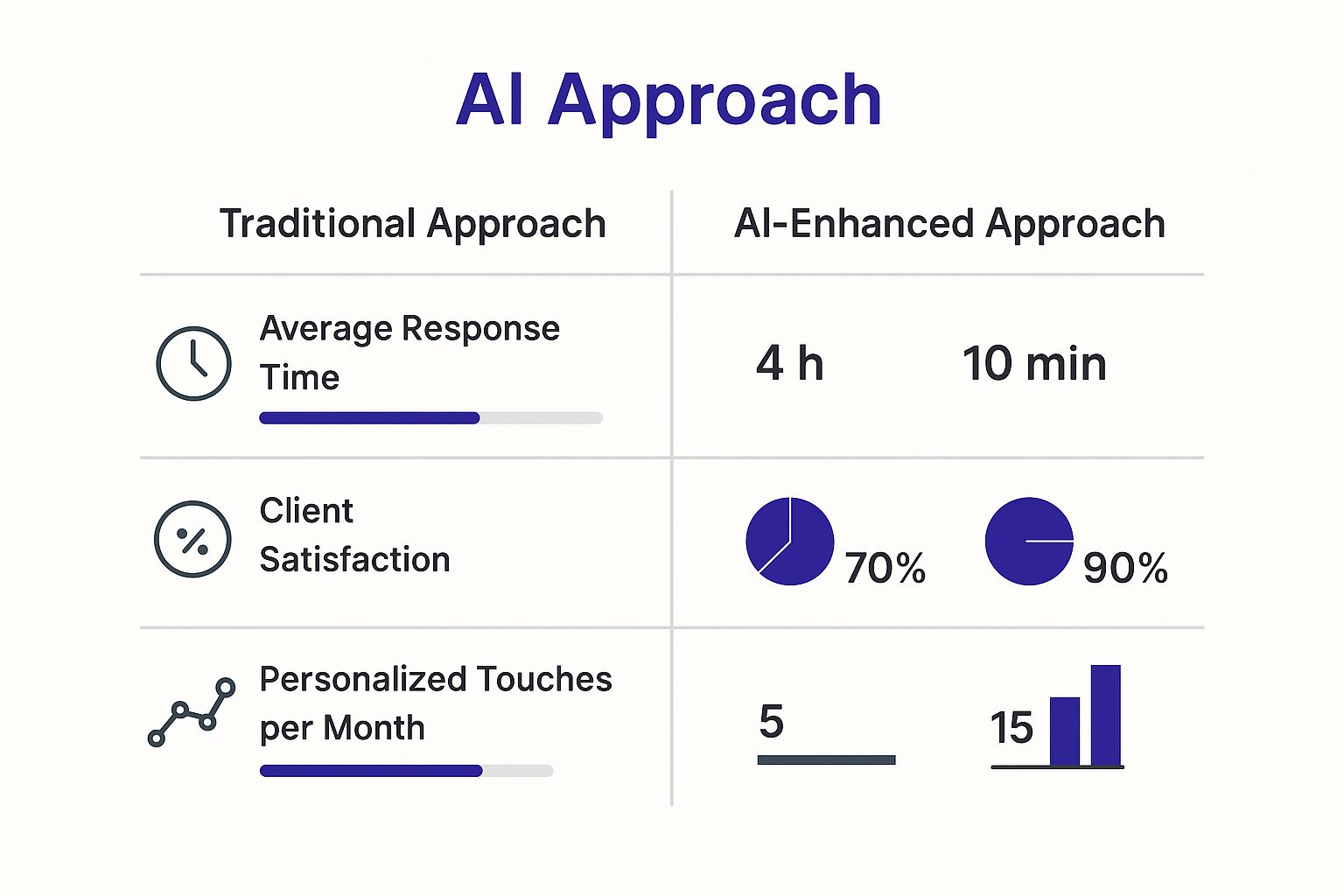
The numbers speak for themselves. You see massive improvements in response times and client satisfaction, proving that technology, when applied correctly, elevates the quality of your interactions.
This move toward tech-assisted client management isn't just a small trend—it's a seismic shift. The global customer service software market, currently valued around $14.9 billion, is projected to explode to $68.19 billion by 2031. This isn't just growth; it's a clear signal that businesses are hungry for tools that help them build better, more durable client relationships. You can dive deeper into the customer service market's rapid expansion on AnswerConnect.
Tools like CRMs and AI assistants are becoming essential for building and maintaining strong client connections. Here’s a quick breakdown of how different technologies can help.
Each of these technologies plays a unique role, but they all work toward the same goal: creating a smoother, more personal, and responsive client experience.
Ultimately, learning how to build rapport with clients in this day and age is about finding that perfect blend of a genuine human touch and smart technology. When you automate the mundane, you create more time and space for the memorable. That’s the balance that lets you deliver exceptional service, every single time.
Even when you have a solid game plan, building real connections with clients can bring up some tricky situations. Let's tackle some of the most common questions I hear and break down exactly what to do.
If you want to build rapport quickly, it all comes down to two things: solid prep work and genuine curiosity. Before you even think about getting on a call, you need to do your homework. Look into the client, their company, and what’s happening in their industry. What have they been celebrating lately? What hurdles might they be facing?
When you finally connect, your goal isn't to sell—it's to listen. Ask smart, open-ended questions about their goals and what's keeping them up at night. Dropping in a specific detail you found in your research, like mentioning a recent product launch or a news article they were quoted in, shows you’ve put in the effort.
Finding common ground helps, of course, but don't force it. Authenticity is everything.
The real goal is a genuine connection, not just a fast one. A relationship built on a flimsy, rushed commonality will break. One built on real understanding and respect will last.
When things go wrong—and they sometimes do—fixing the relationship takes a bit of humility and a clear plan. The moment you realize there’s an issue, you need to address it head-on. Own your part of the mistake completely. No excuses, no blaming.
Then, immediately lay out your plan to make it right and give them a realistic timeline. Actually following through is the most critical part. Keep them in the loop with proactive updates so they're never left guessing.
Once the dust has settled and the problem is solved, a quick follow-up call to make sure they're happy shows you’re committed to their success. When you handle a screw-up this way, you can actually come out of it with an even stronger relationship.
You absolutely can. Building rapport from a distance just requires being more deliberate and creative. My rule of thumb? Default to video calls. Seeing facial expressions and body language makes a world of difference compared to a simple phone call or email.
Try to kick off your meetings with a few minutes of non-work chat. It helps build that personal connection. You also need to be incredibly responsive on tools like Slack or email. It shows they're a priority, even if you’re miles apart.
One small thing that goes a long way is sending a thoughtful follow-up note that not only summarizes the important points but also mentions a personal detail you talked about. It makes a remote interaction feel much more personal and connected.
The impact of AI on client relationships really depends on how you use it. When done right, AI can be a huge asset. Tools can handle the simple, repetitive tasks 24/7, giving clients instant answers and showing your business is on the ball. This frees up your team to handle the nuanced, high-stakes conversations where a human touch is essential.
But be careful. A clunky chatbot that sends a frustrated client into an endless loop will destroy rapport in seconds.
The best strategy is a hybrid one. Let AI handle the straightforward questions, but make sure it can smoothly pass the conversation to a real person when things get complicated. This approach gives clients the best of both worlds: the efficiency of automation and the empathy of a human expert.
Ready to use AI to build stronger, more human connections with your clients at scale? Upcraft offers conversational AI agents that engage leads and clients with personalized, timely communication, so you can focus on the relationships that matter most.
Enter your contact information and Archer will start a conversation with you via text message.